
The Grammar of Deterrence: Nuclear Signalling in a Multipolar Age
Deterrence is a language, and it was built for two speakers. A world of several nuclear powers strains its grammar to the breaking point.
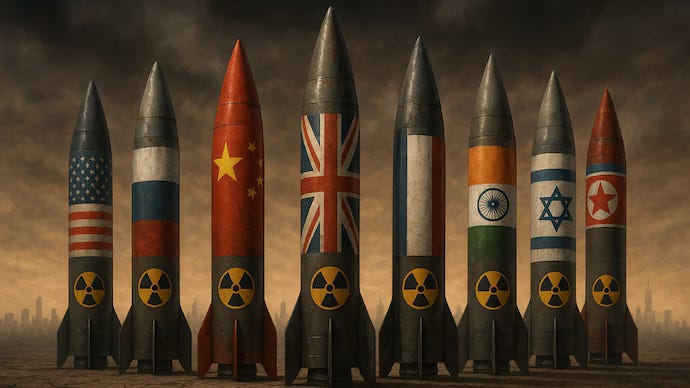
Deterrence theory matured in a world with two principal nuclear actors, each watching the other with a clarity that repetition made almost intimate. That clarity was never comfortable, but it was legible. A multipolar nuclear order — several arsenals, several doctrines, several sets of intentions to be read at once — strains the grammar of deterrence in ways the classic theory was not designed to handle.
The bilateral age had one perverse advantage: simplicity. Two adversaries could, over decades, build a shared vocabulary of thresholds and taboos, until each could anticipate the other's reading of a given move. That hard-won mutual intelligibility was the real stabiliser — more than any treaty — and it is precisely what a crowded nuclear landscape erodes. Rebuilding it among several actors at once, each with its own doctrine and its own fears, is a far harder problem than the one the theorists of the last century believed they had solved.
Signalling was hard enough with two
Deterrence works by communication: a state must convince an adversary that the costs of a given action will outweigh the gains. In a bilateral standoff, both sides spend decades learning to read each other's signals, and even then the record is full of near-misses born of misperception.
Add a third and fourth nuclear actor and the interpretive burden multiplies. A move meant to deter one rival may be read as aggression by another; a posture calibrated for one relationship may be destabilising in a second. The channels through which resolve is communicated grow crowded and noisy.
New technologies, shorter fuses
The interpretive problem is compounded by weapons that compress the time in which signals can be read. Hypersonic delivery, cyber intrusion into command systems and the entanglement of nuclear and conventional forces all shorten the interval between warning and decision — and a shorter fuse leaves less room to correct a misreading before it becomes irreversible.
When the technical margin for error narrows, the political margin has to widen to compensate: clearer doctrines, more reliable communication, and a shared understanding of what must never be touched. The alternative is to trust that speed and ambiguity will never coincide in a crisis, which history gives no warrant to believe.
Ambiguity: shield and hazard
Some deliberate ambiguity is stabilising — it complicates an adversary's planning and preserves flexibility. But ambiguity that leaves genuine intentions unreadable invites exactly the miscalculation deterrence exists to prevent. The line between prudent opacity and dangerous confusion is thin and easily crossed.
Arms-control architecture, much of it inherited from the bilateral age, was built to reduce precisely this uncertainty. Letting it lapse without replacement removes the guardrails at the moment the road is getting more crowded.
Extended deterrence under strain
Much of the world's nuclear stability rests on extended deterrence — the promise by a nuclear power to defend non-nuclear allies with its own arsenal. That promise is inherently harder to make credible than a threat to defend oneself, and a more crowded, faster nuclear environment strains it further. Allies watch anxiously for any sign that the guarantee is weakening.
If they conclude that it is, some may seek arsenals of their own, and each new entrant makes the system harder still to read. The alternative to a credible extended guarantee is not a simpler world but a more proliferated one — which is why reassurance is not charity to allies but a pillar of the nonproliferation order itself.
The task ahead is to rebuild the vocabulary of restraint for more than two speakers — before a misread signal writes the lesson in a way no one can revise — because in the nuclear domain, unlike almost every other, there is no opportunity to learn from the first catastrophic mistake.
Dr. Elena Marchetti
Senior fellow in international security; former adviser on multilateral affairs.